


Last year was an exceedingly difficult one for navigating college admissions. A monumental breakdown in the financial aid process ground down students, parents — and even the most dedicated high school counselors.
The federal government tried to make its Free Application for Federal Student Aid, or FAFSA, easier for students to use. Instead they essentially broke the online form for marginalized students in particular who most rely on it to get help paying for college. It’s unclear whether the problems that came up last year will be fixed for this year’s seniors.
I had a front row seat to last year’s FAFSA debacle, sitting in the office of Lavon Robinson, who was in his eighth — and it turns out final — year as a counselor at Downers Grove South High School in Chicago’s southwest suburbs. What I saw and heard drove home just how much counselors do to help students figure out where to go and what to do after graduation. And just how much last year’s financial aid complications discouraged students from pursuing higher education.
October 2023
On my first visit to Lavon’s windowless, closet-like office, I notice the little touches he’s added to make the space more homey. Across from Lavon’s desk is a loveseat students can nestle into. Next to that is a small side table with a mini Zen garden.
This particular morning a teen is perched on the loveseat cross legged. She needs help starting her college essay. Lavon asks her to think about her core values.
“Financial stability, success and peace,” she says.
Lavon asks how she defines “success.”
“Money, being able to provide for everything I want … and for my family,” she says. “My mom was a single mother. And watching her provide for me and my brother alone… . She did a great job. But, I just know I want to be wealthy.”
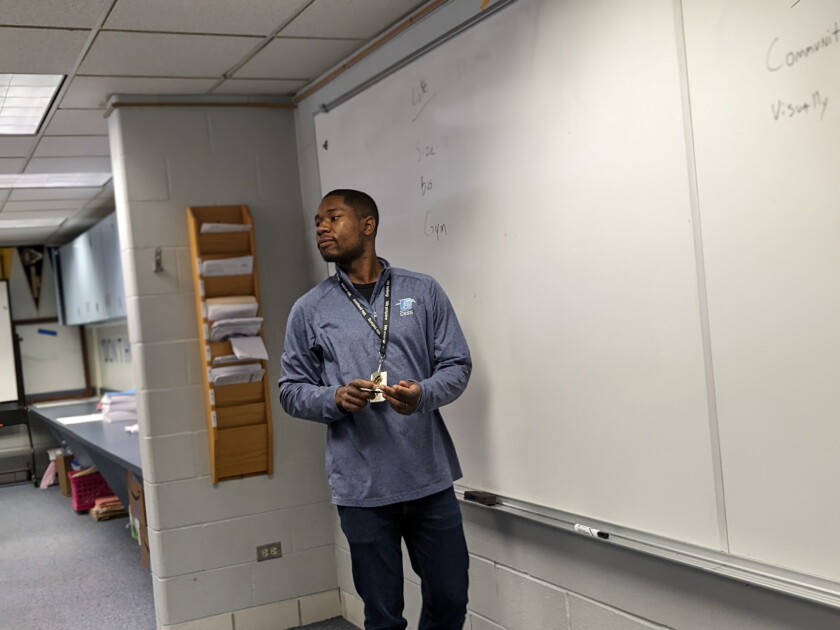
Lavon says he started discussing core values with his students a couple years ago.
“It’s a good way to really get to know people and help them know themselves and figure out what’s important to them,” he says.
I didn’t talk or maybe even think about my core values until I was well into my thirties. It’s one of the many reasons that, if I could go back and do high school all over again, I would want to have Lavon or someone like him as my college counselor.
Before getting into applications or essays, he asks students’ about their latest game, or their plans for winter break or the prom.
Lavon says his high school counselor didn’t get to know him like that.
“I was a very average student. I got fine grades, I was an athlete. And I didn’t quite know what I wanted to do,” he says. “I ended up getting recruited by Illinois Wesleyan to go there to swim … I felt like there, I really kind of found my passions and kind of figured out who I wanted to be.”
Now he lives to help other students find that same opportunity.
It’s not an easy task. Lavon has 140 students on his caseload. Applying to college involves a million and one steps.
And there’s this thing that seems to weigh on his mind every day: The students who most need help are the least likely to seek it out.
“We have plenty of marginalized students here whose parents didn’t go to college and they come from low-income status and they have to take care of siblings, and they need someone to just follow them step-by-step and guide them throughout the process,” he says. “It’s a lot to get students to feel comfortable to ask questions their wealthy classmates don’t need to ask.”
Doing this with only eight hours in a school day — and two young children at home — is a lot.
And helping students is about to get a whole lot harder.
December 2023
A week before winter break, Lavon counsels a senior who is worried about the FAFSA, the free application for federal student aid. Students have to fill it out to get access to public loans and grants for college. It usually opens at the beginning of October, but it’s late.
“We made [a Federal Student Aid] ID,” the student says. “I did it like weeks ago, and I never got anything back. And my mom did it like months ago, and she never got anything back.”
Federal officials were supposed to release a new version of the form that was easier to use. Halfway through the school year, it’s still not available. That doesn’t leave Lavon a lot of time to help students fill it out.
“I am nervous the FAFSA is going to come out on Dec. 31, and students are going to be like, ‘Oh, I gotta do it right now.’ And they’re going to make an error and then that’s going to delay their financial aid packages,” Lavon says. “I just worry that, with it coming out when high school and colleges aren’t in session, it’s going to be harder for us to support students.”
The FAFSA opens on New Year’s Eve, as Lavon predicted, but the situation is far worse than he had imagined. The application is riddled with bugs and errors. They go unfixed for months and make the form — and financial aid — even harder to understand and access for the students who most need it.
The ones whom Lavon wants so badly to help.
April 2024
Graduation is just three weeks away. A senior walks into Lavon’s office wearing a shirt that reads, “Art is the lie to help unsee the truth.” The student needs his help figuring out how much she is going to have to pay to attend Illinois State University. But, because of the FAFSA mess and the delays its causes, all Lavon can do is guess.
“I’m thinking that $8,000 will be the most it can be,” Lavon says, pointing to a number on her computer. “Here the federal government said that this is what your mom can pay for college. Since that’s a negative number, in theory they shouldn’t be charging you a lot more money than that.”
For now, that’s all the information the student has to go on to make a decision about how she will spend thousands of dollars and the next four years of her life.

It’s extra uncertainty and confusion heaped on top of an already inaccessible and confusing process, Lavon says.
“A lot of my low-income students … are just like, in some ways, barely bought into going to college,” he says. “When students see like, ‘Well, this FAFSA thing still can’t be figured out,’ it just furthers distrust in the whole process, which makes it hard, because we know there’s a lot of value in a college education.”
To say it’s made Lavon’s job more difficult is an understatement.
“It’s created for college counselors a lot more pressure, just to make sure that students are in a good spot,” he says, “and just maybe a little bit of paranoia of, ‘Will my students be OK?”
The bell is about to ring. It’s been a day, and Lavon is more than ready to head home to see his wife and two young kids. But I have one more question to ask him:
“What do you think would make the whole system better for … low-income and marginalized students?”
“More support,” he says. “But I mean, trust starts at an early age and it’s ingrained in our society of not trusting the educational system … so I don’t have a clear answer. And I always tell my colleagues, ‘I’m going to control what I can in my office and support students that come see me.”
“And obviously I’ll try to advocate for students outside of office — but make my focus on what I can do in my office.”
I’m sure that’s a good way of not getting burned out, I tell him.
“And not getting overwhelmed,” he says.
September 2024
Graduation and the summer have come and gone, and I hear Lavon has left Downers Grove South for a new job at a different school. I wonder if, despite his best efforts, he got burned out.
We hop on Zoom to talk.
“I wasn’t unhappy at Downers Grove South,” he says. “It was just kind of like small things, like, ‘Oh, it’d be nice to take the train. It’d be nice to have a smaller caseload. The extra money would be nice.’ ”
He says he’s not doing college planning anymore, just social-emotional counseling.
“I can just kind of unwind on the train and leave my computer at the office and not worry about what kind of panicked college email I’m going to get,” he says.
I ask if the FAFSA “broke him.”
“I think a big takeaway from last year is that … the college process will always favor the wealthy and the kids who come from college-educated backgrounds, for a variety of reasons,” he says. “I think that a lot of work needs to be done to support students who come from marginalized backgrounds.”
Lavon plans to continue to do some of that work by volunteering for a nonprofit that mentors low-income students to and through college.