


As part of the agreement that brought down the pro-Palestinian encampment at Northwestern University last spring, two scholars and five students from Gaza are arriving on the Evanston campus this fall.
WBEZ’s Lisa Kurian Philip met with one of the scholars, a visiting professor of political science, who arrived in Evanston a month ago after fleeing Gaza for Egypt. He shared his personal story, which has been edited for brevity and clarity.
My name is Mkhaimar Abusada. I know my first name is very difficult [to pronounce]. Even in our society, it’s not a very common name.
I was born and grew up in a place where everything is politics. Back in 1948 … my father and my mother were expelled from their villages in historic Palestine. That’s the beginning of our story.
I was born and raised in Gaza in a refugee camp called Jabalia refugee camp. … When we were in high school, what we used to do is to throw stones at or bricks at the Israeli army. This is part of what Palestinian resistance was back then. And I ended up getting jailed for a week back then by the Israeli army for doing that activity.
I came about 35 years ago to this country and I finished my master’s degree in Chicago at Northeastern Illinois University. Then I couldn’t really handle the weather here … as someone who spent most of his life on the Mediterranean, which is warm and nice even in the wintertime. So I went a little bit down south to Missouri. And I went to University of Missouri, Columbia, where I finished my PhD in political science.
Right after that, I went home. I went back to Gaza with my wife and two children who were born in the U.S. I have been teaching at Al-Azhar University in Gaza for the past 27 years.
Gaza wasn’t in turmoil by the time I went back in 1997. But still, the culture, the values, the basic services you receive in Gaza are completely different from the U.S.
You try to make your life better, even though there isn’t electricity 24 hours [a day], or there isn’t decent transportation, or there isn’t decent health care. Being a professor at the university and getting paid in a good way, you can always deal with that by, for example, buying a generator for electricity.
But there isn’t anything you can do when you are in a war zone, when there is an eruption of violence. You just try to go to a supposedly a safe place, or supposedly a place where you can escape death and escape injury. I still remember my little daughter was scared to death all the time from military tension and escalation.
What’s going on now is much, much worse.

When Hamas waged that attack against Israel [on October 7], I was still asleep. My wife came and woke me up and said, “Something big is happening,” because there were rockets being fired against Israel. And whenever rockets are being fired, you can hear the noise.
We turned on Al Jazeera, and it didn’t take long to discover … that Hamas fighters crossed the border from Gaza into Israel with their pickup jeeps, pickup trucks, trucks with machine guns, and were taking over some Israeli communities there.
I knew that it’s not going to be an easy situation. [Because of] the attack that Hamas carried out on Oct. 7, killing 1,200 Israelis and taking hostages, [I knew] we were going to be subjected to severe Israeli retaliation.
On Oct. 13, the Israeli Army issued a general instruction that all Gazans living in the north of Gaza must evacuate to the south of Gaza. At the first moment, I didn’t want to leave. I thought, “Where to go? You take your wife and kids, and where do you want to go?”
We always remember the first Palestinian Nakba in 1948 … and we have always blamed our fathers and grandfathers: “Why did you leave?” I was thinking to myself, “People look to me as a role model. If I leave, who’s gonna stay?”
But then, this is what happened: My brother’s apartment looks over a main street in Gaza called al-Rashid Street, which connects Gaza from the north all the way to the south. And from the early hours of that morning, you could see thousands of Palestinians packing their personal stuff and leaving to the south.
So my wife and kids, they came to me and they said, “Look, people are leaving. If we don’t leave, we might just die.”
I told them, “Okay, we’re gonna go back to our apartment to take some of [our belongings], because it’s going to be a long journey.”
I told my kids, “Pack some of your winter clothes and say goodbye to our apartment. We might never go back again.”
We were evacuated by the American Embassy in Cairo at the beginning of November. The Israeli army, after Oct. 7 … very much destroyed the new campus of my university. And we have an old campus, which was also heavily damaged as a result of the war. So I started to think to myself, “Rebuilding and going back to normal academic life is going to take a long time in Gaza.” So I started to look for a job in the U.S. or in Europe.
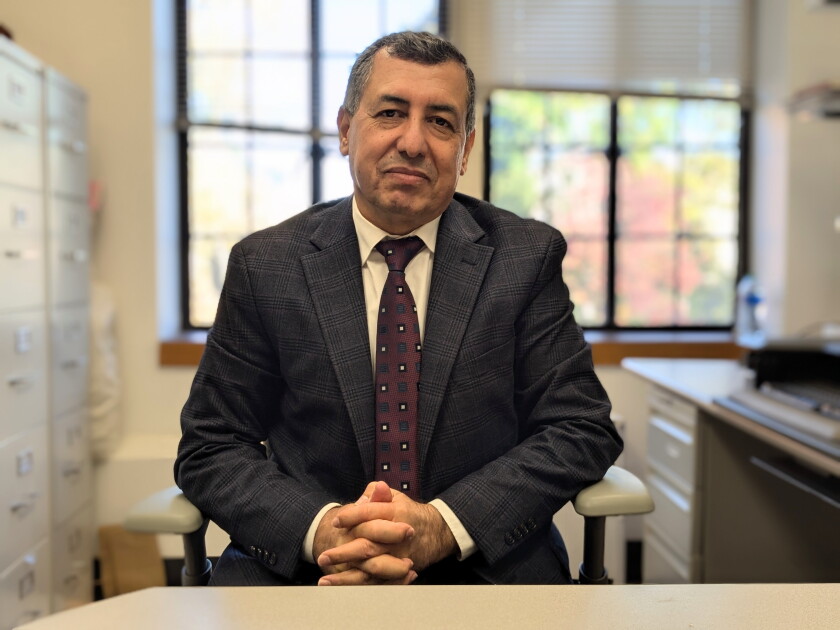
Then I got this offer from Northwestern. They have a program … where they invite scholars from war zones or countries that have … political upheaval. The minute they sent me the offer letter, I signed it and I said, “I’m coming.”
At least here, I’m working, I’m sending money to my wife and children, who are in Egypt now. Going back to Egypt isn’t going to do any good for any of us.
No one … ever thought we’re gonna be in the situation we are in now, an all-out war by Israel against the Palestinians. More than 42,000 Palestinians are killed. Almost 100,000 are injured. There are hundreds missing. There’s destruction all over the place.
I hope during this time that I’m spending at Northwestern … I will be able to be the voice of the victims of this war, to be the voice of the forgotten Palestinians.
Here in Evanston, I love to walk by the lake, maybe for one simple reason: It reminds me of Gaza’s beach. That’s what I used to do when I was in Gaza. … So this is part of soul healing, I guess.