

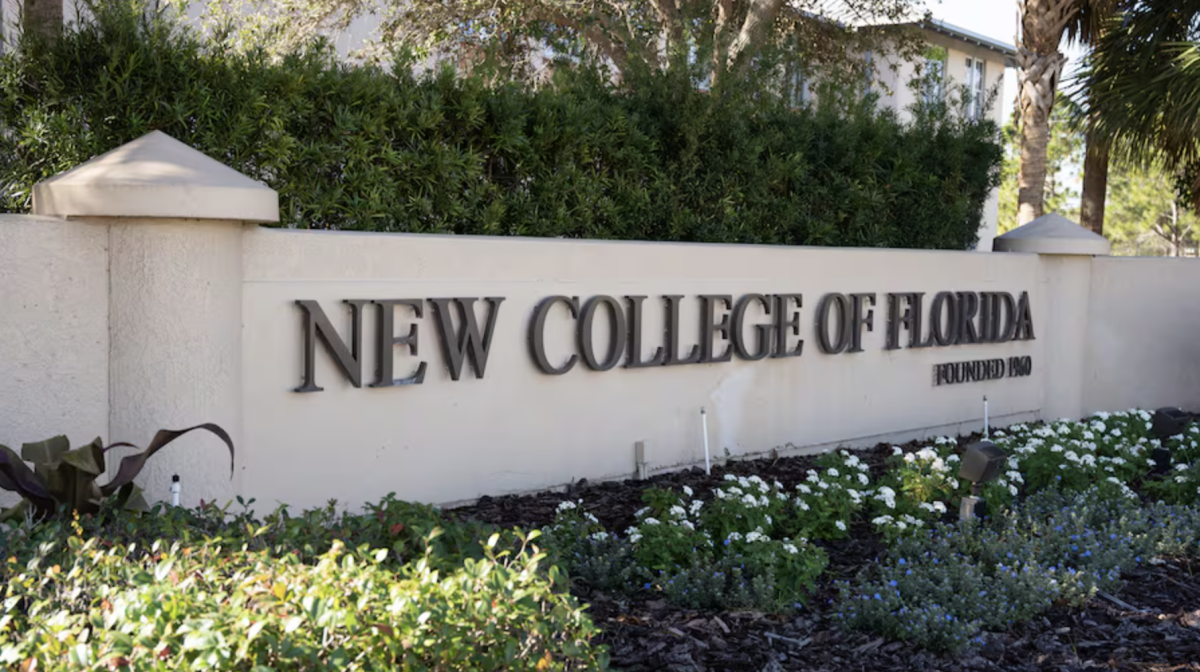
Faculty and students at New College of Florida criticized changes adopted this week to the school’s mission statement and core curriculum, saying they were made with little input from the academic community and threaten its reputation as the state’s honors college.
The changes were approved Tuesday during a heated virtual meeting of New College’s board of trustees — the school’s governing body overhauled two years ago by Gov. Ron DeSantis to reform the once progressive-leaning campus.
New College president Richard Corcoran defended the changes, saying they represented the culmination of years of work and planning, with many opportunities for community input.
To some, the changes further entrench DeSantis’s effort to reorient the school in a more conservative direction.
Since then, the school closed its office of diversity, equity and inclusion, abolished the gender studies program and hired a host of “presidential scholars” aligned with Corcoran’s vision. It’s also seen record high enrollment — bolstered by the school’s nascent sports program and generous scholarships.
Chris Kottke, a mathematics professor who served on the school’s general education committee, criticized the most recent changes with a reference to New College’s old mission statement.
“Tuesday’s events mark a further step in the transformation of the identity of New College away from a school that ‘prepares intellectually curious students for lives of great achievement’ and towards a school that is seen as safe for conservative parents to send their kids to,” Kottke wrote in an email.
‘Great traditions and moral disciplines’
In an 11-to-2 vote, the board replaced the school’s mission statement over objections from faculty and student representatives, scrapping the school’s previous 206-word statement in favor of one half as long.
The previous statement identified New College as the state’s honors college and hinted at the school’s progressive aspirations to “discover new knowledge and values.” Its replacement removes the honors signifier, andis firmly grounded in conservative principals, placing emphasis on tradition and history
“As part of man’s long struggle to defeat ignorance by pursuing truth, New College educates its students in the great traditions and moral disciplines of our civilization so that they can lead principled lives of consequence,” the statement reads.
Patrick McDonald, a mathematics professor who represents the school’s faculty, argued that the message was vague, “ugly” and failed to convey the school’s status as Florida’s honors college.
“I’m not against (a) change in the mission statement; I welcome one,” McDonald said, “I’m against this one because it’s badly written, and it will discredit the college.”
Frequent requests for updates from school faculty had gone unanswered, he added.
Student government president and trustee Olivia Mikkelson echoed that complaint, claiming that students had heard nothing since an initial meeting in April. Mikkelson said she felt she was left out of the loop while the statement was being drafted.
“As a trustee and student representative, I didn’t receive any updates or have the opportunity to give feedback because the process was not communicated in a clear way,” she said.
A frustrated Corcoran pushed back, saying the new mission statement would not impact the school’s designated status as Florida’s honors college. Administrators had solicited input from the community over the past year, he said.
“There was never a constructive alternative proposed in all of this time,” he said. The feedback he’d received was either positive or so inappropriate “I can’t repeat it in a public meeting.”
The remaining trustees made minor adjustments before passing the statement.
If the new mission’s appeals to the “great traditions and moral disciplines of our civilization,” sound conservative or antiquated, that’s kind of the point, said trustee and author Mark Bauerlein.
“We should lean into our niche and say who we are,” Bauerlein said after the meeting. Despitedwindling student population at liberal arts schools, classical conservative colleges are pulling record enrollment, he said.
“It’s a disservice to young people and it’s morally wrong to abandon the humanities,” Bauerlein said. “If we stand by a belief in classical education, students will come.”
‘A complete lack of transparency’
If the school’s mission statement represents a symbolic change in ideology, the newcore curriculum puts it into practice.
Trustees approved the roster of required classes that will go into effect for the 2025-26 school year, overhauling the prior framework and putting the curriculum in line with new state regulations.
The changes came under fire Tuesday from some faculty as rushed, opaque and overly narrow.
The courses were selected “with minimal faculty input and a complete lack of transparency,” said literature professor Nova Myhill, who serves as chair of the faculty educational policy committee.
Kottke, the mathematics professor who helped draft a version of the curriculum approved by faculty in May, said their recommended framework was modified by the administration without the committee’s approval.
Most professors weren’t aware of the changes until associate provost Manuel Lopez Zafra presented the curriculum at a Nov. 13faculty meeting, he said.
When professors asked why their courses didn’t make the cut, Lopez Zafra told them “because that is what the president wants,” Kottke said.
Lopez Zafra did not respond to multiple calls and emails.
The narrow framework shoehorns students into courses that reinforce western ideology, Kottke said.
Students can only fulfill their humanities credit through a course on Homer’s “The Odyssey,” and social science requirement through classes on American history and civics.
“It’s ironic given that indoctrination was given as a reason New College needed to be reformed in the first place,” Kottke said. On Wednesday, Kottke and three other faculty members resigned from the school’s general education committee.
The class list should be even shorter, Bauerlein countered.
“It’s a shared experience centered around a body of works seen as essential,” Bauerlein said. “There’s value in being prescriptive.”
The list of classes isn’t final and can be revised next year as needed, Corcoran said.
“We can continue to have that discussion,” he said. “But we need to move forward because we are under the gun, and that gun is the law in Tallahassee.”
Ian Hodgson is an education data reporter for the Tampa Bay Times, working in partnership with Open Campus.