


Santa Ono, the University of Michigan president tapped last week to lead Florida’s flagship university, had a bumpy week.
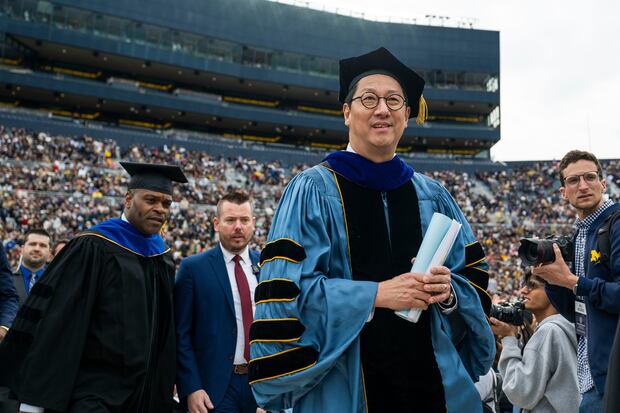
Hours before he was announced as the sole finalist for the University of Florida’s top job Sunday, Ono was booed during a commencement address in Ann Arbor over his handling of campus protests.
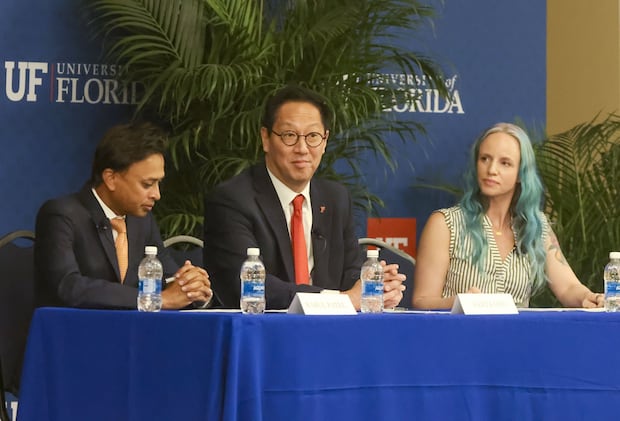
Two days later, he received standing ovations on UF’s Gainesville campus.
The divided reaction reflects deeper confusion — among both critics and supporters — about Ono’s evolving stance on divisive cultural issues, raising questions about whether his shifts reflect pragmatism or political convenience.
That confusion extends even to some of the conservative commentators who helped shape Florida’s higher education agenda.
On Monday, Christopher Rufo, a New College trustee who led the conservative critique embraced by Gov. Ron DeSantis and others on critical race theory and diversity, equity and inclusion, called Ono “a left-wing administrator.” He added on X that “Florida deserves better than a standard-issue college president.”
Just two days later, Jesse Arm, the executive director of the Manhattan Institute think tank — where Rufo is a senior fellow — offered a sharply different view.
“Sensing the changing cultural winds,” Arm wrote, Ono had begun “steering one of America’s most prestigious public universities back toward sanity.”
On Fox News, however, U.S. Rep. Byron Donalds, an early favorite in next year’s governor’s race, called Ono unfit to lead the state’s top public university and urged the search committee to start over.
DeSantis weighed in by midweek. While not directly endorsing Ono, he made clear that no one out of step with the state’s stance on diversity, equity and inclusion, or DEI, would be a finalist.
Ono has long positioned himself as a progressive institutional leader, but his about-face on issues like diversity, climate change and the COVID-19 pandemic leave some students and faculty wondering what kind of leader Ono promises to be.
New views on diversity
In the wake of George Floyd’s murder in 2020, Ono, then president of the University of British Columbia, made a commitment to support marginalized communities.
“An inclusive university is one which actively confronts and overcomes systemic barriers faced by different groups and enables everyone to realize their full potential,” Ono wrote in an open letter to the UBC campus community.
Two years later, Ono and Michigan launched “D.E.I. 2.0,″ a plan that included 20 action items including community outreach to underrepresented groups and campus-wide accessibility.
“While we have made progress — and we have — we still have much more to do,” Ono told the crowd gathered at his induction ceremony. Michigan’s program rocketed spending on diversity to more than $18 million in 2024, according to emeritus economics professor Mark Perry.
In March, Michigan closed its Office of Diversity, Equity and Inclusion and discontinued the D.E.I. 2.0 initiative. The school banned diversity statements in admissions and faculty hiring decisions and directed university departments to “evaluate their web presence … for compliance with federal executive orders and guidance.”
The announcement celebrated the program‘s success increasing the number of first-generation and lower-income students, but said it was necessary to stop those efforts largely because “federal actions against DEI programming have intensified.”
On Tuesday, Ono elaborated on why he closed the diversity office.
“I made the decision, and it was me who made the decision, to use those dollars to directly impact all students, all Americans, based upon merit,” Ono said.
Ono said too many resources were going to support the diversity office’s growing staff, and the return on the school’s investment was greater spent on student aid than bureaucracy.
As Ono addressed diversity programs during Tuesday’s forum, he voiced skepticism of the underlying mission to prioritize resources for historically underrepresented groups.
“For me it’s the American thing to do to support all students, not just some students,” he said. “Not everyone agreed, but I truly believe that these are right decisions for not only an institution, but for a state and for our nation.”
“I have the same views as this governor; it’s completely consistent with state and federal law,” he added.
Changes on climate, COVID-19
Ono has similarly shifted his stance on climate change and the COVID-19 pandemic.
Under Ono’s leadership, the University of British Columbia committed to a full divestment of fossil fuels in response to student activism and a recognition of the “climate emergency” fueled by carbon emissions, Ono wrote in an essay published by Inside Higher Ed.
In 2022 Michigan served as the lead institution for the University Climate Change Coalition. The coalition of North American Universities committed to climate change action. That year, the university invested $300 million to help companies develop environmentally responsible practices.
Ono vowed to cut in half campus greenhouse gas emissions by 2025 and said the school’s endowment would offset carbon produced by its investments by 2050.
But at Tuesday’s event, Ono said UF’s role is to “do research that’s based on science” and that he would not “provide any political perspective” on the issue.
Ono was president of the University of British Columbia when the pandemic hit and moved swiftly to close the campus and require vaccinations for those who returned. The school was criticized when it decided in 2022 that it wouldn’t allow back students who chose not to disclose their vaccination status.
UF, largely guided by state rules, recommended but did not mandate masking and vaccination.
At Tuesday’s event, Ono said that “UF got it right” on its pandemic response. The University of British Columbia‘s policy of secluding students had detrimental effects to both mental health and their academic performance, Ono said.
Andrew Larsen, 19, who serves as UF’s student senator for the college of arts, appreciated Ono’s diplomatic answers but worried his alignment with DeSantis could make it difficult to find common ground with others on issues like diversity, equity and inclusion.
“I was concerned by his insistence that he uniformly agrees with state policies,” Larson said.
“He follows his bosses,” said Meera Sitharam, president of UF’s faculty union. “He looks for where the power is and goes with it. … At UF, that’s DeSantis and (Board of Trustees Chairperson) Mori Hosseini.”
Ono defended his evolving stances as pragmatic, not political. He framed himself as a “servant-leader,” someone who adapts positions based on new data and feedback from the university community.
Whether that flexibility is an asset or a red flag remains an open question as Ono awaits formal approval from the UF Board of Trustees and the state Board of Governors. His record may offer the best clues to how he’ll lead.
“If the governor wants to interfere with curricula, who is he going to side with?” Sitharam said. “We’re going to have to see.”