

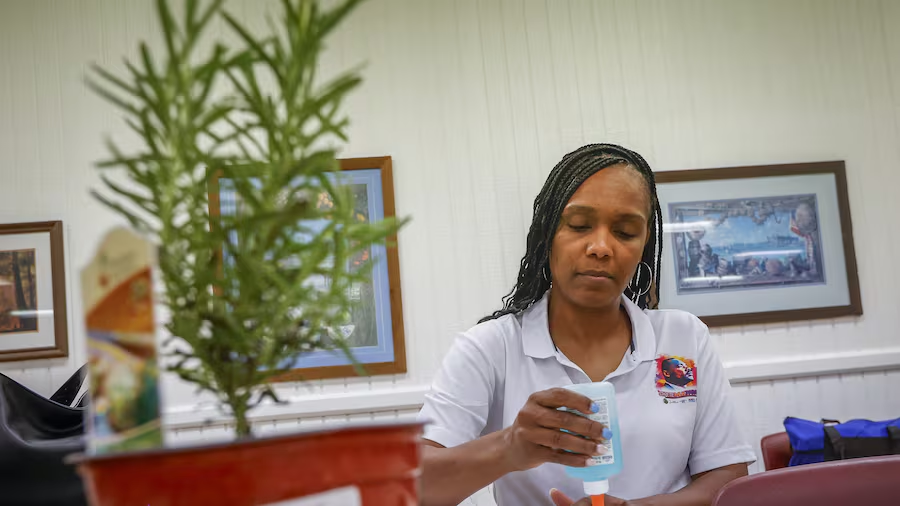
LARGO — Jeannie Necessary balanced a child-safe knife over a cherry tomato.
She curled her fingers in a technique called the “claw” which often amuses children, she explained to a room of a few dozen teachers and community members.
“Start with the tip, and then cut,” she said, moving on to orange peppers and freshly washed lettuce.
Her audience mirrored the steps back to her and smoothed scoops of hummus — the glue — over tortillas.
The recipe is one that attendees can replicate in their classrooms or in their communities, Necessary said. She is a specialist at the Family Nutrition Program, a project of the University of Florida’s extension service.

The program is shutting down at the end of the month, due to federal funding cuts to Supplemental Nutrition Assistance Program-Education, known as SNAP-Ed, though the One Big Beautiful Bill Act.
With the bill’s passage, the government will cease funding SNAP-Ed programs like the Family Nutrition Program, which received nearly $9 million this year. More than 70 program employees across 31 counties will be laid off.
This closure means families across Florida will lose access to information about healthy eating habits and how to prepare fresh foods. School districts could be left without outside expertise and students will miss workshops about where their food comes from.
“(Getting) little hands in the dirt, and helping them to feel the dirt and learn where it comes from, and then grow the food and taste the food,” said Karla Shelnutt, an associate dean and a professor of family, youth and community sciences. “It’s all part of this education.”
A long-threatened loss
The first version of SNAP-Ed began in the 1970s. It’s a project of the U.S. Department of Agriculture that teaches educators and families how to efficiently spend their SNAP dollars, cook healthy meals and include movement in their daily lives.
Many Americans are not aware of what SNAP-Ed programs do, said Jennifer Morgenthal, the programs manager for Florida Agriculture in the Classroom, which partnered with the Family Nutrition Program to host the school garden leadership trainings.
People won’t understand the effect of the funding cuts, she said, when they don’t understand that SNAP-Ed programs are different than SNAP benefits and include more than food banks.

The Family Nutrition Program is one of Florida’s two SNAP-Ed initiatives, Shelnutt said. It focuses on children and teenagers primarily, she said, while Feeding Florida mostly works with adults.
Losing funding is a reality that program staff have faced over the years, Shelnutt said.
“There’s always been the threat to the government shutting down, what a pause in funding would look like,” she said.
Florida lost some SNAP-Ed funding in 2010, when Congress passed the Healthy, Hunger-Free Kids Act, which changed the funding model, Shelnutt said.
That year, she said the Family Nutrition Program decreased outreach and let go of some staff in the middle of the year. Although the program ended up gaining the funding back, it still shook up their operations.
Necessary said she didn’t think there was anything coming that would cut the program completely.
Shelnutt was in the mountains of Italy on a study abroad trip in May when her phone started buzzing. Message after message from her colleagues across the country popped up on her screen. The House version of the One Big Beautiful Bill Act had come out, and it cutfunding for SNAP-Ed programs completely. About $536 million was allocated to SNAP-Ed programs across the country this year, and about 4% of that went to Florida’s two SNAP-Ed programs.
She turned on the House agriculture committee meeting, and waited to see if any amendments would be added, if anything might be saved. She had a bit of hope until the bill passed through the Senate, too.
There’s a handful of health and environment policy issues that are super polarizing, Morgenthal said. There’s also a large number of policy issues that never become polarizing, she said, because people almost always believe in the science.
Morgenthal is working on her doctorate at UF, and is taking a class about how to deliver science-backed information in a non-partisan way.
“Researchers are taking those courses, especially in the Ag world, so that we can communicate better,” she said. “Because there’s a responsibility to do it.”
What’s at stake?
Samantha Harris, a community advocate who works with the St. Petersburg Sustainable Urban Agriculture Coalition, said she can see by peeking at grocery store carts that so many families aren’t educated about how to access healthy options.
She said she appreciates the program’s focus on food preparation, in addition to purchasing healthy options.
“You know, I get it,” she said. “My kids are much older, but I was a parent. I needed to be able to get home and feed them something that wasn’t McDonald’s or Burger King.”
In urban areas, Necessary said there’s often an oversaturation of programs to address food insecurity and promote access to healthy foods. They’re often specialized, she said. One program might tackle building gardens and another might advocate for changing school lunch standards.
The Family Nutrition Program combines those components, she said.
“I think in these rural areas it’s really valuable,” she said. “Because it ends up that we may be the only program they have access to in their communities.”

Much of the program’s work is about helping students and their families make healthier choices.
They’ve helped school districts redesign cafeterias with character-themed food signs, like “X-ray Carrots,” Necessary said. More students started taking lettuce from a school garden in Lee County after the program suggested a creative name contest.
Program specialists go into classrooms to hold taste tests for students, Shelnutt said, where they can try fruits and vegetables without their families wasting money on food a student might not like. If a student lives in a food desert, or doesn’t have access to fresh food, specialists like Necessary have worked with the local government to set up a community garden.
They have also advocated for school lunch policies that require healthy options like fruits and vegetables be served every meal, Shelnutt said, and found ways for gardening to align with school curriculum standards.
Teachers and community members learned how to make seed balls, make watermelon juice — a sweet drink with no added sugar — and glue seeds to a paper towel for germination at last week’s school garden leadership training.
“They’re able to continue it,” Shelnutt said. “Even though we might not be there.”