


When Joe French’s great-grandfather started his family farm back in the 1890s, he went with a central crop with a proven record: tobacco. It served the family well for several decades, right up until the 1990s when tobacco reforms made it harder for small farmers to profit off the plant.
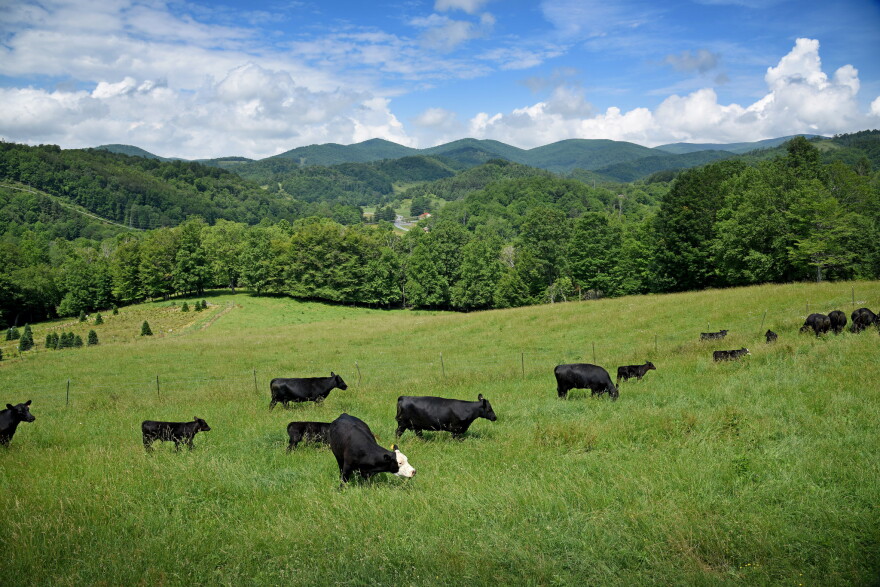
The family decided to pivot to beef cattle farming, which brought about a new problem — how to keep up with feeding them. Right around the time, North Carolina’s Cooperative Extension was launching a new program focused on just that. The Amazing Grazing program taught farmers how to use temporary fencing to substantially increase their livestock feeding capacity and improve farm ecology.
French says he’ll never forget bringing the poly wire innovation home to his dad.
“It’s a big spool, looks like a big fishing reel with string on it,” French said. “I showed it to him and I told him what we were going to do and he said, ‘You’re crazy, cattle will not stay in a string.'”
“Now, we use poly wire everywhere,” French continued. “It really did work. It changed our lives.”
North Carolina’s Cooperative Extension Program has been around for more than a century. It started in 1914 with a partnership between the state, federal government, and N.C.’s two land grant institutions: N.C. A&T State University and N.C. State University.
The cooperative is made up of four field laboratories, 18 research stations, and 101 offices — one for each county and the Eastern Band of Cherokee’s Qualla Boundary. The extension agents’ main focus is to help farmers solve agricultural problems.
Their efforts range from guidance on what seeds to plant to mitigating invasive tick species feasting on livestock. Changing technologies and weather patterns have forced their advice to evolve to include solutions like where to get hay after Helene washes it all away, keeping pastures green amid the state’s historic drought, and how to incorporate autonomous devices like drones.
French, the cattle farmer, ran one of the state’s research stations for 30 years. He’s now an assistant commissioner with the N.C. Department of Agriculture and said N.C. Extension is a “driving force” that keeps farming moving forward in the state.
“By the time information gets to the extension agent, that information has been vetted to the point that using what they’re recommending is really going to work,” French said. “… that is the key. The countries that don’t have that infrastructure in place are just one disease away from disaster, because they’re not going to know how to react to it when it happens.”
The cooperative also goes beyond the field. Extension agents provide thousands of nutrition education initiatives for adults and families, as well as early agricultural education for local youth through 4-H programs.
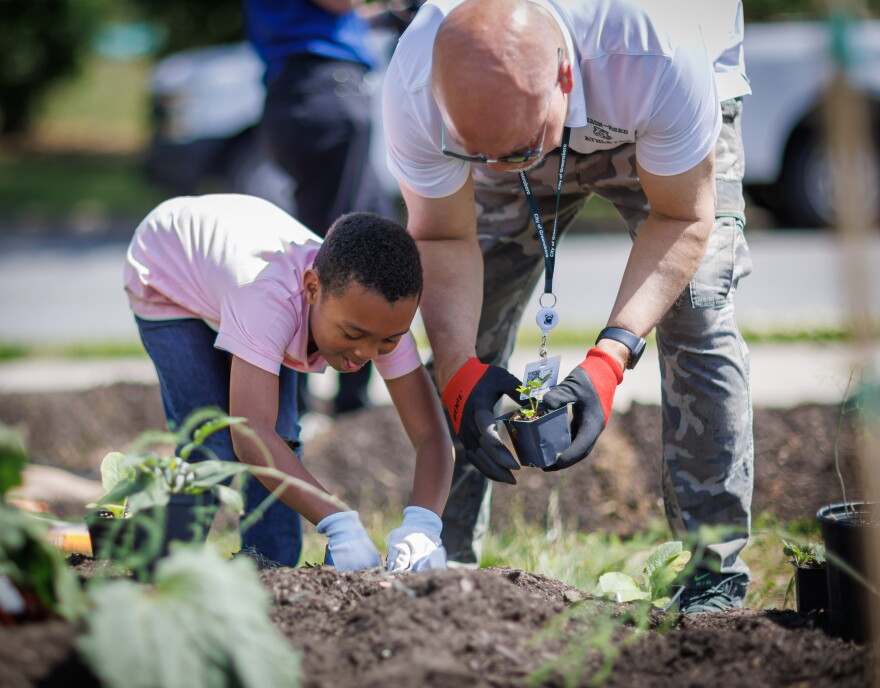
At N.C. A&T State University, that can range from teaching kids about renewable energy, to hosting farmers markets to help people with SNAP access cheaper fruits and vegetables, to reworking unused land into produce beds to address food deserts.
There’s about 1,300 extension agents who serve six million North Carolinians annually. Most of that work is headquartered at N.C. State University, where Ben Chapman is associate director. He says as the state’s largest non-formal educational outreach program, extension often brings in people who otherwise wouldn’t interact with the university.
“We take local needs, whether it’s agriculture-based, community-based, whether it’s around health for individuals — and we really try to take the best available science to solve problems that are out there,” Chapman said. “We are doing the research, training the people that will go out and talk about this. (That’ll) work back and forth with farmers or businesses in a way that’s outside of government structure.”
The initiative is sponsored by counties, state, and federal governments. Local counties provide nearly $50 million, funding more than half of the 101 centers’ work annually.
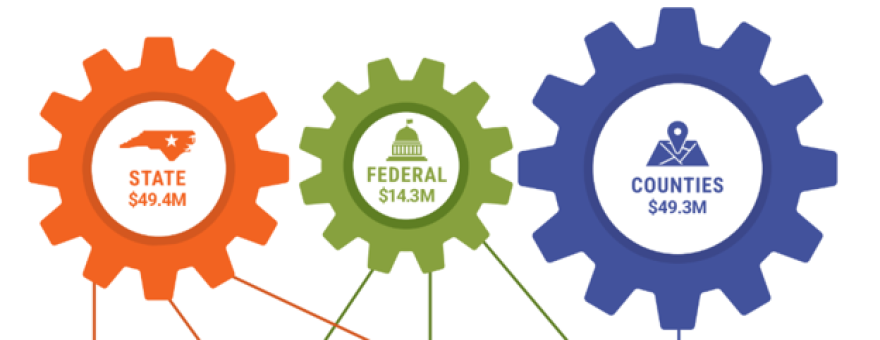
State and federal legislators use a matching funding model to provide money. In the past, state budget cuts have led to large reorganizations. These days, that’s mostly smoothed out with the state spending nearly four times as much on extension as the federal government.
The gap appears to be growing as federal officials cut funding for some extension initiatives. Chapman said at the end of this year funding will run out for extension’s nutrition education program for people with SNAP benefits, SNAP-Ed.
“We’ve had a number of grants and contracts that have changed or shifted priorities over time,” Chapman said. “We know that there’s a need and a priority around nutrition education, but the funding mechanism has changed. So, we always have to be nimble and have to think about where are those emerging issues coming (from) and how do we deal with a changing landscape, both federally and at the state level.”
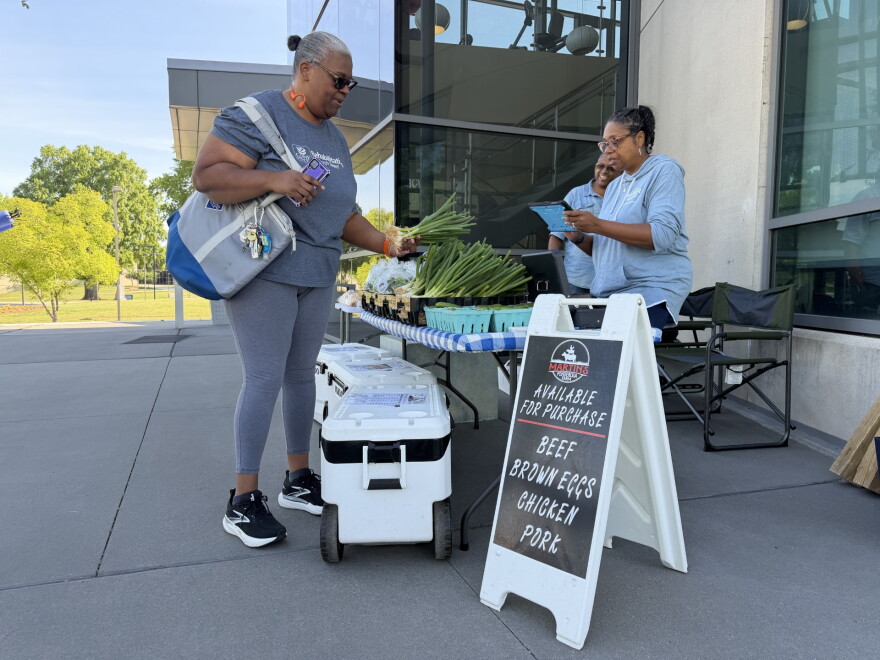
Shewanna McSwain is one of those extension coordinators who’s had to adjust to funding changes. She runs ‘Try Healthy’ at N.C. A&T State University, a federally-funded program that provides nutrition information for people who are eligible for SNAP or EBT benefits.
“It may look a little bit different, but we still try to meet the needs of the community,” McSwain said. “If someone comes to us who is struggling, maybe because they can’t feed their family or they’re skipping meals — we try to connect them to community resources. Families can utilize (our edible landscape) to pick produce to stretch their food dollars. We are working on building a farm-to-fridge program … that’ll also be free of charge.”
There’s also several emerging needs Chapman would like to address at the associate director-level.
“Whether that’s in technology, AI, mental health and stress and wellness — being able to access funds to build those programs is something that’s always a challenge,” Chapman said. “But we have really great people — faculty members, agents, and county extension directors — that are out there hustling and looking for other funding sources to meet those needs.”
French, the farmer and assistant agriculture commissioner, said his department is currently working on a collaboration to solve some of those problems. They want to build ‘digital agricultural innovation hubs’ in rural counties to train farmers on the latest agricultural technologies, from artificial intelligence, drones, to autonomous tractors.
He recently set out for Plymouth to convince donors to invest in the project.