

UNC-Chapel Hill is in the early stages of a ten-year plan to increase its enrollment. By 2034, the university wants to add 5,000 students to its undergraduate class. So far, the school has reached about a quarter of that goal after enrolling its largest first-year class in history this fall.
But trustees and administrators, concerned the university isn’t growing fast enough, want to supersize that target.
UNC-Chapel Hill Trustee Jim Blaine remarked at a summer board meeting that he believes the university’s enrollment selectivity can come across as elitist.
“You can’t be the university of the people if the people can’t get access to your school,” Blaine said.
“I think we need a concrete plan, could we add 10,000, 15,000 more kids to our school,” Blaine continued. “… I would like to see in the near term some models put together about what does that look like, because the other great thing about it is the best way for us to get state money is to enroll more undergraduate students.”
On Thursday, the board passed a resolution requesting administrators to pursue a more aggressive enrollment plan. Trustees noted that in the mid-1990s, UNC-Chapel Hill enrolled 5% of all high school graduates in North Carolina. In recent years, that number has fallen to about 3%.
The resolution calls for the chancellor to gradually get back up to the 1990s rate, starting with enrolling up to 5,000 in-state students in next year’s fall class. In comparison, this fall’s record enrollment included 4,200 students from North Carolina.
By 2030, trustees want to see enrollment go up to 6,250 resident students. And continue to enroll 5% of the state’s high school graduates every year after.
University trustees, however, do not have the power to order the university to grow. The UNC Board of Governors sets enrollment levels for individual universities.
Meanwhile, university administrators have already come up with several scenarios to both speed and scale up Carolina’s incoming class.
The most ambitious of the mix suggests growing enrollment by 10,000 total students by 2032. That target would involve enrolling about 4,700 resident first-year students by 2027. It appears the resolution would involve surpassing that target.
According to a presentation from the university’s chief financial officer, however, a number that high could risk “major impacts” to campus infrastructure and the overall student experience.
The formula is simple: The more aggressive Carolina chooses to grow, the more capacity needs are likely to arise.
The day before trustees passed the enrollment resolution, CFO Nathan Knuffman detailed how growth could impact six infrastructure focus areas: housing, dining, campus recreation, study space, classrooms, and office space.
Solutions to address needs in those areas range from tweaking the main campus dining hall to only serve students with university meal plans, converting classrooms to general purpose spaces that any academic department can reserve, and pushing higher rates of upperclassmen to off-campus living options.
“We believe we can serve more North Carolina residents,” Knuffman said.
“I do think as you get further down to the right on that chart and serving more and even beyond those numbers, I think it will just require us to add more capacity quickly,” Knuffman continued. “To change some of the culture and policy on campus more quickly. And really just leverage that state support and be innovative on the financing side.”
Student Body President Devin Duncan said he’s worried about the university moving “too ambitiously” in enrollment growth. He noted to trustees that changes administrators have made to make room for more undergraduates are already impacting current students’ experience.
He pointed to the main campus dining hall, Lenoir, where administrators have increased seating by adding bar top tables. More students are now able to fit in the space, but now have to stare at a wall while eating their lunch instead of gathering around a table of their friends.
Or in the student union, where clubs and organizations are “fighting for space.”
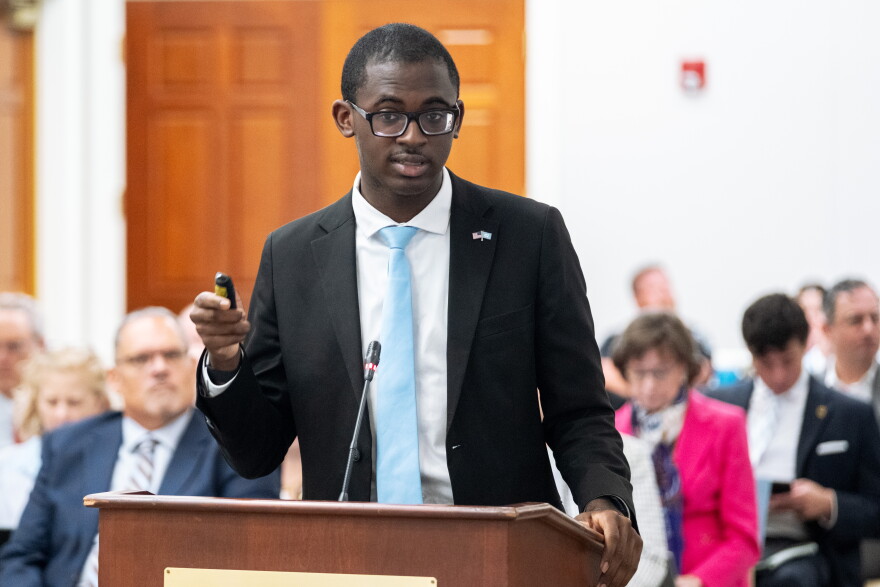
“I would hate for us to get to 2034 and say that we enrolled 10,000 more students, but those students are having a harder time finding a place to live, finding a place to study, getting involved in opportunities and finding community,” Duncan said. “… I can’t say that I’m convinced that we can promise a really good experience at that point. Maybe we can in 10 years with Carolina North, but for the student in the interim as this is happening, their quality or experience may likely go down a bit.”
Duncan also noted the contradiction of administrators cutting upwards of $80 million from the university via its ‘Service First’ plan and the now “aggressive hike” in undergraduate enrollment. He pointed out that staff are feeling overworked and say the enrollment growth plan is putting a lot on their plate.
According to Chancellor Lee Roberts, the “savings” from ‘Service First’ cuts to departments like human resources and IT are being redirected to renovating classrooms, campus safety, and hiring faculty.
“We can’t increase enrollment without a really strong, vibrant partnership with faculty,” Roberts said. “And in particular, with resources being devoted to hiring more faculty and more faculty training and support.”
Roberts told WUNC he doesn’t know how many more faculty he’s going to hire. He said, however, the university has been hiring faculty in high-need areas throughout the process as well as advisors and counselors.
The resolution, after input from the student body president and faculty leadership, includes a section that asks Roberts to increase enrollment “without sacrificing the quality of the student experience and education.”