

A biweekly newsletter about education during and after incarceration. Written by Open Campus national reporter Charlotte West.
College Inside

Sign up for the newsletter
A newsletter about the intersection of higher education and criminal justice. By Charlotte West.
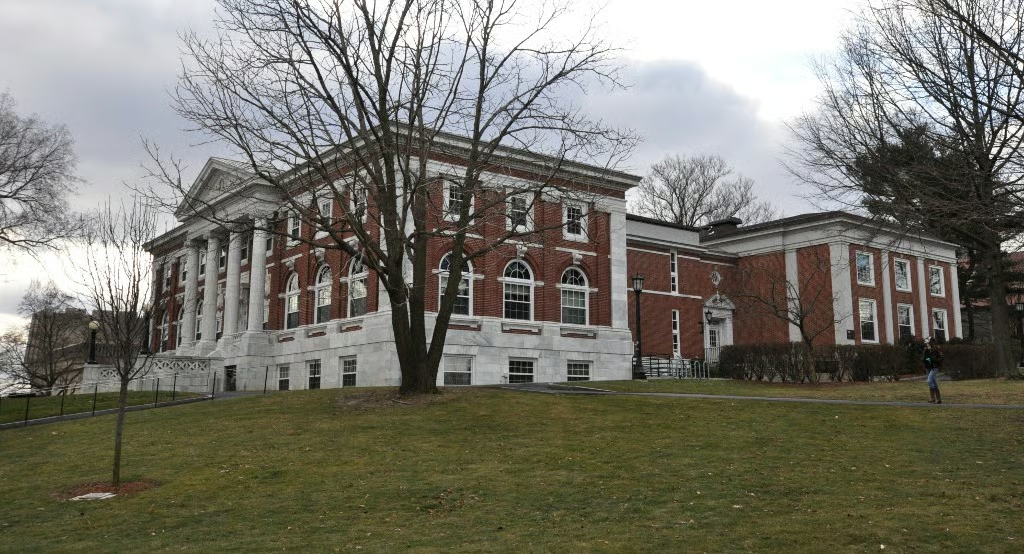
Are universities ready to receive their incarcerated students on campus?
On Friday, I published a story about Tufts pausing its prison reentry program and freezing its bachelor’s degree pathway after a former participant reportedly opened fire off campus in May. It’s not the first time I’ve written about programs shutting down. In Washington state, for example, students’ educations were abruptly halted when a prison shut down, and in the past two years, both Georgia State and Auburn began to wind down their own degree programs inside.
These decisions are rarely just about the students in the program. Ved Price, who leads the Alliance for Higher Education in Prison, said that schools worried about how an incident like the May shooting reflects on its reputation are weighing pressures that have nothing to do with whether the program itself works. It’s also a reminder of how fragile these programs can be — built and sustained by a handful of committed people, dependent on outside funding or on campus leaderships’ continued support
Here are a few other questions that came up for me as I was reporting this story.
1. Do criminal history disclosures requirements help keep campuses safe? While this wasn’t a story about criminal history questions in university admissions, it does speak to the broader questions of how colleges look at students that have a record. Rob Stewart, a professor who studies criminal-history disclosure in college admissions, said that criminal history disclosure is not predictive of who might commit crimes on campus. And, he said, decisions to ask students to disclose their criminal history are not necessarily driven by the people responsible for actual campus safety. They come from administrators, often just watching what peer institutions do.
What the research — and our reporting — does show is that these questions often discourage people from applying at all. Stewart, who is formerly incarcerated, told me he nearly abandoned his own college application after encountering the criminal history question. His own research found a similar chilling effect, and that disclosing a felony conviction nearly tripled an applicant’s odds of rejection.
When I was reporting on this issue earlier this year, a graduate student in Illinois applying to a college he had taken courses from while incarcerated said the process made him feel unwelcome. He wasn’t alone — other applicants I talked to described feeling like they were being treated as a risk to the campus community rather than a part of it.
2. Are universities ready to receive their incarcerated students on campus?
“One thing I hope the broader conversation does not produce is greater institutional caution about supporting students after release,” said Patrick Conway, who directs Boston College’s prison education program, which teaches at the same prison as Tufts. We talked about the broader context for higher education in Massachusetts prisons and about how his institution has built out its reentry program. He worries that other universities will look at what happened at Tufts and conclude the safer move is to keep formerly incarcerated students off campus altogether.
In my reporting on the closure of Auburn’s prison education program, for example, at least two formerly incarcerated students — students of Auburn’s degree program inside — found they weren’t welcome on campus after the university added a new criminal history screening step. This was despite years of promising students they’d remain “an Auburn University student” after release.
Boston College has admitted 130 students to its on-campus degree program since it started its prison program in 2019. “To me,” Conway said, “the situation instead raises important questions about how universities can build those pathways responsibly and sustainably…It is possible to do this at scale and it remains very much achievable — even at ‘elite’ universities that maybe would be a little more wary in these sort of waters.”
3. What happens to incarcerated students whose status at the university is unclear?
Tufts has confirmed that it’s continuing to offer classes inside this fall, and the incarcerated students are still earning college credit. Many of those students, however, are not yet officially admitted to Tufts. This has been a long-standing practice. A former graduate said he didn’t receive formal admission until a few weeks before he graduated, despite taking courses for years. Faculty familiar with the program also confirmed students’ non-matriculated status — meaning they are earning credits but are not currently degree-seeking.
The distinction matters because of what it means for continuity. If students are degree-seeking, accreditation bodies require a university closing a program generally to have a teach-out plan to help current students finish. That was the case with both Georgia State and Auburn, which had to keep offering classes until current students graduated or hand the program off to another college. Students who were never formally admitted don’t have that same protection. A university could, in theory, just pack up and leave students with no degree.
It’s not clear what the outcome of Tufts’ review will be. Patrick Collins, Tufts’ executive director of media relations, did not respond to a question asking whether the students currently taking classes inside are currently non-matriculated or degree-seeking. He said only that the interim provost is working with college deans to develop a BA degree pathway for currently incarcerated students.
Students on the inside have much less freedom of choice — or control — over their education than their outside peers. Many are first-generation college students with limited information about how higher education actually works. They’re relying on the university to follow through on its implicit promise.
If your program has faced something like this, or you want to share how you’ve built campus-based support for formerly incarcerated students, I’d love to chat.
Read the full story here.
Let’s connect
Please connect if you have story ideas or just want to share your experience with prison education programs as a student or educator. You can always reach me at charlotte@opencampusmedia.org or on Bluesky, LinkedIn, or Instagram. To reach me via snail mail, you can write to: Open Campus, 2460 17th Avenue #1015, Santa Cruz, CA 95062.
We know that not everyone has access to email, so if you’d like to have a print copy College Inside sent to an incarcerated friend or family member, you can sign them up here. We also publish the PDFs of our print newsletter on the Open Campus website.
There is no cost to subscribe to the print edition of College Inside. But as a nonprofit newsroom, we rely on grants and donations to keep bringing you the news about prison education. You can also donate here.
Interested in reaching people who care about higher education in prisons? Get in touch at sales@opencampusmedia.org or request our media kit.