


During recruitment season for UNC-Chapel Hill’s sociology department, PhD student Erin Cuellar Wright opens up her Carrboro home for a few nights. A prospective student stays with Wright and her cat as she shows them what it is like to be a graduate student at Carolina.
“And there was kind of a frank back and forth where the candidate made the observation that everyone she spoke to, it seemed like all of us had an extra job — and had to have an extra job,” Wright recalled. “And I said, yes — that is correct.”
The would-be Tar Heel ended up taking a more competitive offer to be a doctoral student somewhere else.
PhD student pay has long been an issue at UNC-Chapel Hill. In addition to a tuition benefit, the public university’s minimum stipend is $21,592 for a nine-month stretch. That is less than half the living wage in Chapel Hill, which is nearly $50,000 without children.
Lately, however, students and faculty say low stipends are not the only issue making it less enticing to pursue a PhD at Carolina.
“It feels a bit like they see us as a cheap labor source lately,” says psychology PhD candidate Annaliisa Powers. “I don’t really feel like we’re valued very much (and) I don’t feel like there’s transparency on big policy changes.”
Powers started at UNC-Chapel Hill right before the pandemic and has been working to get her PhD in cognitive psychology for the past eight years. She said in that time, she noticed supports quietly disappearing for graduate students.
It started a couple of years ago with fewer placements to teach summer courses and reduced travel awards for conferences.
This year, it accelerated.
Administrators announced they were taking away graduate student housing to make room for a planned increase of undergraduate students. They are also more harshly enforcing policies that affect how much graduate students can work and how long they stay in school.
“Every time they need to make a cut somewhere, it seems like the cut is from graduate students,” Wright, the sociology PhD student, said. “It seems over and over again that we are a population that seems expendable or optional.”
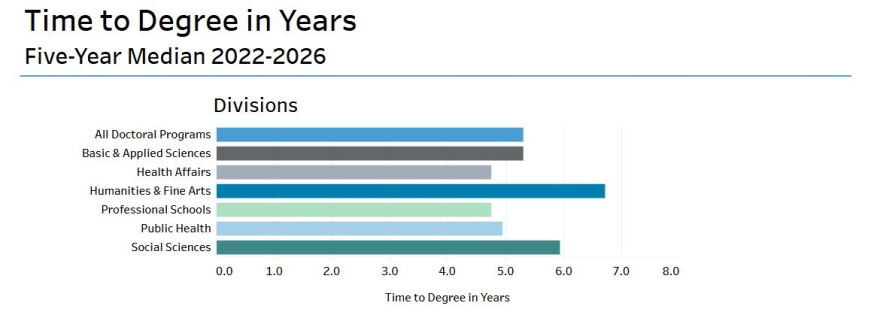
Although Wright’s graduate funding package is low, it has always been her one guaranteed source of income. That has allowed her to plan for completing her graduate degree in six years, which is the norm for her program.
This summer, however, the UNC-Chapel Hill Graduate School announced that it would be more harshly enforcing a policy that limits how long it will fund doctoral students.
Fully-funded graduate packages at UNC-Chapel Hill typically include a stipend, tuition remission, health insurance, and campus fees. For a while, many PhD seeking students have been able to earn these packages for upwards of seven or eight years by teaching classes or conducting research.
Now, they have to finish their studies in five years or figure out how to pay their own way.
The five-year limit could hurt UNC’s ability to attract grad students
Graduate School Dean Beth Mayer-Davis said the policy has been in place for several years, but administrators just have not been enforcing it.
“It used to be that we had enough resources and not such a huge demand on those funds that we could keep providing them beyond the 10 semesters,” Mayer-Davis said. “But now we’ve realized that we don’t have that luxury. So, over a three-year period — not right away — but over a three-year period, we will be more attentive to adhering to that 10-semester opportunity.”
Mayer-Davis said she is being “more watchful” with state dollars. UNC-Chapel Hill has been in financial turmoil this past year, as administrators work to cut more than $80 million from the university’s budget.
What may seem like a small change in how many years PhD students receive funding could result in a significant hit to UNC-Chapel Hill’s national reputation.
Several of the university’s peers, including UC Berkeley and Michigan, have some programs that guarantee funding for six or more years. Just a couple of miles down the road at Duke University, administrators also typically limit funding to five years, but pay graduate students twice as much.
Scott Duxbury is the director of graduate studies for UNC-Chapel Hill’s sociology department. He said he thinks a five-year timeline is possible, but that does not mean it is ideal.
“We are simply not going to attract the students who want to do ambitious research, who want to do the best things,” Duxbury said. “If that’s the case, we’re losing out to our competitors and we’re not growing our reputation at the standard that we have been historically.”
This past year’s sociology PhD cohort is less than half as many students the department wanted to enroll. They also received about 100 fewer applications than average.
Duxbury said the shifting enforcement of policies, compounded with the university’s low stipends, are devastating students’ morale. And in turn, his department’s ability to attract.
“These are the signals we get — it’s not even about who can we recruit, it’s about who’s willing to consider us,” Duxbury said. “The fact that those numbers are going down sharply as well, it’s scary. I would call it a warning sign, but I think it’s past the point of a warning. It’s hemorrhaging.”
Impact on undergraduates
The changes around graduate student funding can also trickle down to the undergraduate learning experience.
In sociology, for example, graduate students teach 39% of undergraduate classes. Duxbury foresees that percentage going down if his department struggles to recruit graduate students.
They will likely fill the gaps, he said, by hiring more contracted teaching faculty. This is a strategy his and other departments are already deploying to lessen the teaching burden for teaching assistants and prepare for the university’s strategic swell of undergraduate students.
Administrators want to increase Carolina’s undergraduate class by 5,000 students in a decade. Trustees want to raise that goal even more.
“We’re finding ways to be able to swing it. I don’t think it will devastate us at kind of the numbers level that people are often looking at,” Duxbury said. ” But in terms of the quality of instruction? I mean, these are just some of the best teachers on campus. And so, not having those classes? It’s bad for our undergraduates, I think.”
In other parts of the university like chemistry, administrators have stopped offering recitations, smaller classes where students review materials from lectures, in part because of fewer available teaching assistants. Graduate students told WUNC that another policy enforcement in the College of Arts and Sciences capped how many hours graduate students can work for the university, preventing TAs from picking up additional work like leading recitations and study sessions.
Mayer-Davis, the graduate school dean, said the university does not admit students because it needs them to teach.
“Hiring a teaching assistant is actually a very expensive way to teach,” Mayer-Davis said. “Now we do it in pretty large numbers of graduate students because it helps to support those graduate students. And because it’s an excellent experience for those graduate students.”
Mayer-Davis noted that while the graduate student population dipped at UNC-Chapel Hill overall this year, it largely came from a decline in international students pursuing master’s degrees as well as a few programs where faculty opted to accept fewer students due to uncertain federal research funding.
She said her job as dean is to do all that she can, despite headwinds, to provide “reasonable support” to graduate students.
“We’re running as fast as we can,” Mayer-Davis said. “We hear the students. We see the stressors that they’re under. Our goal is to do the very best we can for their support, their well-being, and their being able to learn and to thrive.”
Graduate students feeling “discarded”
Back in Carrboro, Wright is worrying about her future as she rushes to finish her sociology degree one year ahead of schedule. She said given the conditions graduate students are facing now, she would find it “unethical” to encourage others in the current environment.
“We are not given the education environment that we thought we were entering,” Wright said. “We then teach the undergraduate body for five years — at an incredibly low-wage rate — and then are discarded.”
“Those who have chosen to invest in the UNC community and think that pursuing a PhD would give us the future career path that we’re sacrificing for,” Wright continued. “We have been proven wrong.”