


Britney Smart, a PhD student at the University of Illinois Chicago, went into public health research to answer one alarming question: Why are Black women in America three times more likely to die while giving birth?
“No one should have to think about ‘Am I going to die having a baby in this country?’ ” she said.
Smart’s research focuses on keeping more Black women safe during childbirth. But her work and that of countless other young researchers is now imperiled by President Donald Trump’s upending of federal research funding.
Although a court has temporarily blocked the administration’s drastic cuts to funding for research institutions, the flow of grants from federal agencies like the National Institutes of Health and the Centers for Disease Control and Prevention has slowed to a trickle. The administration has particularly focused on defunding research in any way related to diversity, equity and inclusion, which some scientists and health researchers say has become integral to more and more federal grants in recent years.
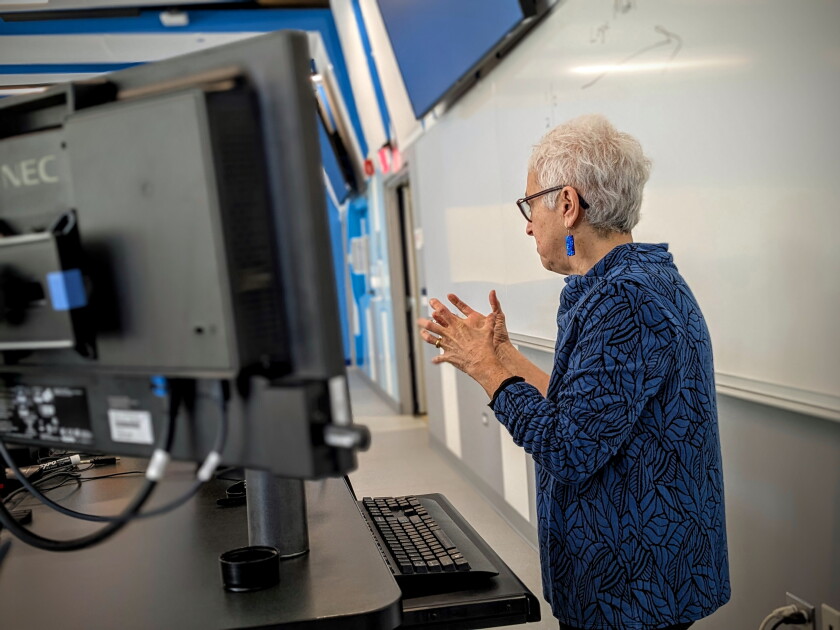
The chaos of the Trump administration is hitting UIC researchers who are just starting their careers, like Smart, especially hard. They are unsure of whether or not federal grants, a key source of funding for public health research, will exist to support their work.
Smart, who is originally from Trinidad and Tobago, relies on a National Science Foundation fellowship to fund her PhD. The agency has started flagging keywords as simple as “racism,” “diversity” and “women,” so she’s not sure if she still has that funding.
“Public health is under attack — maternal and child health is under attack, and it feels particularly insidious how the infrastructure we’ve developed is being stripped for parts,” Smart said. “It also feels incredibly intentional, trying to tell folks something about who matters and who deserves to have rights and who deserves to be protected.”
The uncertainty has made budgeting for individual researchers and institutions nearly impossible. Some universities have paused graduate school admissions or taken down job postings because they don’t know if they will have funding to take on new students or researchers. Officials at UIC have implemented what they are calling a “hiring chill,” under which new hires, including graduate assistants, require approval from top administrators.
“I’m looking for the next thing, and I’ve seen positions that were available the week before, and then you go back to open the application and the position’s gone,” said Maggie Butler, a postdoctoral fellow at UIC’s School of Public Health. “It’s just a 404 page.”

Butler and her colleague Minji Kang Huh are worried about their careers, but they are even more concerned about the communities they serve.
Kang Huh’s research focuses on helping marginalized women gain access — and a say — in their health care. She said the United States has a history of using coercive practices, like forced sterilizations, against minority communities. She said that mistreatment continues to the present, when providers pressure women of color, for instance, to use an IUD instead of allowing them to choose contraception they feel is right for them.
Addressing this mistreatment requires research, she said.
“We are trying to find the gaps in order to help people reach this equitable level of health, and so it’s hard with an administration that is so focused on removing that,” Kang Huh said. “It takes away a lot of our ability to do what we need to do in order to help communities, and so that feels just as overwhelming and defeating.”
Still, Kang Huh is committed to continuing on as a researcher, but she said she would not be surprised if other people opt out altogether.
“I would hope that it empowers people to work harder and fight harder, but I don’t blame people if they feel defeated and don’t want to get into this field,” she said. “What is propelling people to want to do this work if they’re going to be stopped at every corner?”