


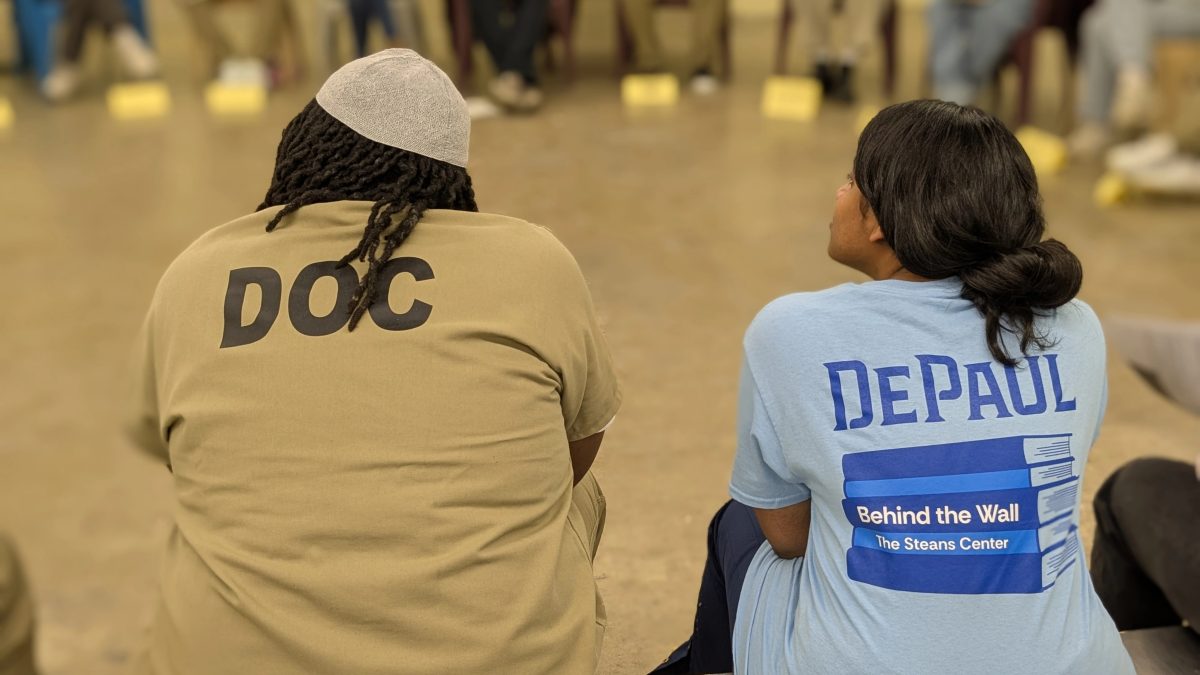
A group of students sit in a big circle in the basement of Chicago’s Cook County jail, listening in rapt attention to DePaul University Professor Jen Kouba. About half wear sand-colored jumpsuits with “DOC” written on the back. The other half are dressed in powder blue t-shirts with “DePaul” written on them.
It’s a typical class session in the Inside-Out program, which brings together campus-based students with incarcerated students for quarter-long courses. Founded in 1997 at Temple University, the program is now taught in hundreds of correctional facilities across the country. DePaul offers at least one of these classes at Cook County jail every quarter.
Only first names are used here, and outside students are told not to look up why their inside classmates are here at the jail. Both groups receive the same college credit from DePaul University.
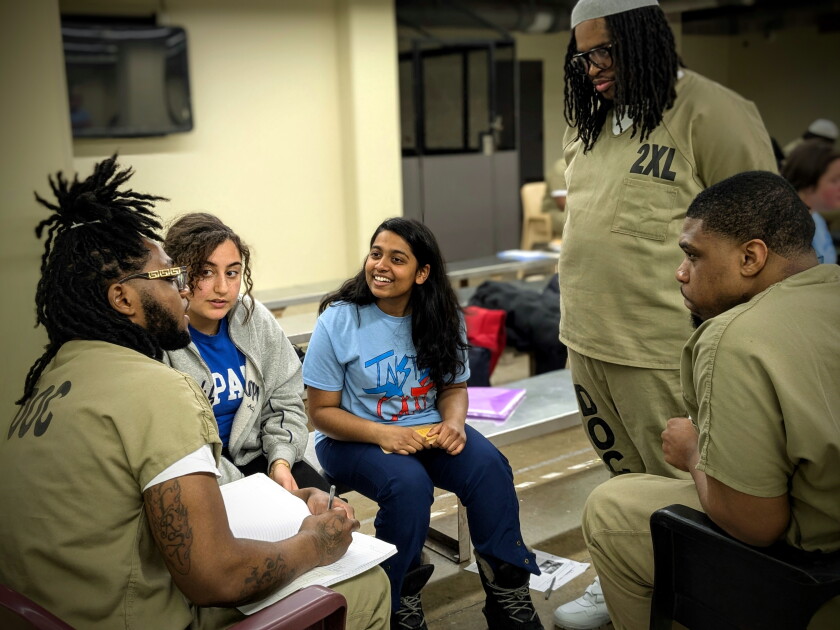
Today’s focus: homelessness — a topic Kouba finds particularly fitting for this unique classroom.
“There are deeply embedded societal beliefs about unhoused neighbors, just as there are assumptions about people impacted by the carceral system,” says Kouba, an adjunct professor of peace, justice and conflict studies. “And the inside students are the first to acknowledge that they had assumptions about me and the outside DePaul students.”
Kouba has the class break into small groups to talk about different problems and stereotypes surrounding homelessness.
In one corner, a group debates policies prohibiting people from sleeping in their cars.
“So, if I park my car there it’s fine, but as soon as I sleep in the car, it’s not fine,” one student observes.
An inside student shares his own experience with homelessness: “I was living in Indianapolis out of my car, and they kept bothering me and telling me I can’t sleep here. So I started sleeping in Walmart parking lot, because that’s where all the truck drivers sleep. They’re still bothering you, knocking on your window. ‘You okay?’ Like, bro, what’s going on?”
“You’re almost criminalized for just existing,” another student interjects.
Across the room, another group creates a dictionary of terms to describe homelessness using art, essays, and poetry.
William, one of the incarcerated students, reads a poem he wrote to define “humanity.”
“What you see when you look at me, my smell, my hair, my clothes, never asked how do I have to survive an everyday struggle?
What about that man hustling, making sure his family eat?
He got stuck raising siblings. He never obtained his degree.
The money he make off the street is worth the risk of being harassed by the police.
Instead of judging we should have more empathy towards others’ needs.
Maybe we wouldn’t have so many lost dreams.”

William has participated in an Inside-Out class before. He said this current session has been eye-opening.
“It shocked me,” he explains, “because I didn’t realize so many women are homeless, and they experience so much more than men – it’s not talked about.”
Molly, an outside student in the group, is a journalism major. She says she often talks about topics homelessness and the prison system in her classes at school, but those often feel like something separate from their reality on campus. “Writing stories on it doesn’t feel right,” she says.
Having the opportunity to take a class at the jail has made those topics much more real. And as a future journalist, “being able to talk to people from so many different backgrounds is really helpful,” Molly says.
Nearby, a different group explores the definition of “home.”
“A place where you can feel safe,” offers one student.
“A place where you can feel safe and comfortable and yourself. You can let go. You can relax, kick your feet up,” adds another.
“It could also be like a feeling that you get,” suggests a third.
“Yeah, true,” the group agrees.

For Kouba, teaching inside the jail requires creativity because the teaching environment is pared back. She tells the students she’s working to get permission for art supplies for their dictionaries.
The limitations also come with benefits – the outside students have to leave their phones in little lockers in the lobby before the metal detector they have to pass through.
“Students are more likely to talk to one another when they don’t have a phone in their hand,” she says.
In no time, class is over. The students in sand-colored jumpsuits return to their housing units. The students in powder blue shirts head up the stairs and out into a frigid, cloudless day to take a van back to campus.
Lisa Kurian Philip, who covers higher education for WBEZ and Open Campus, contributed to this story.