

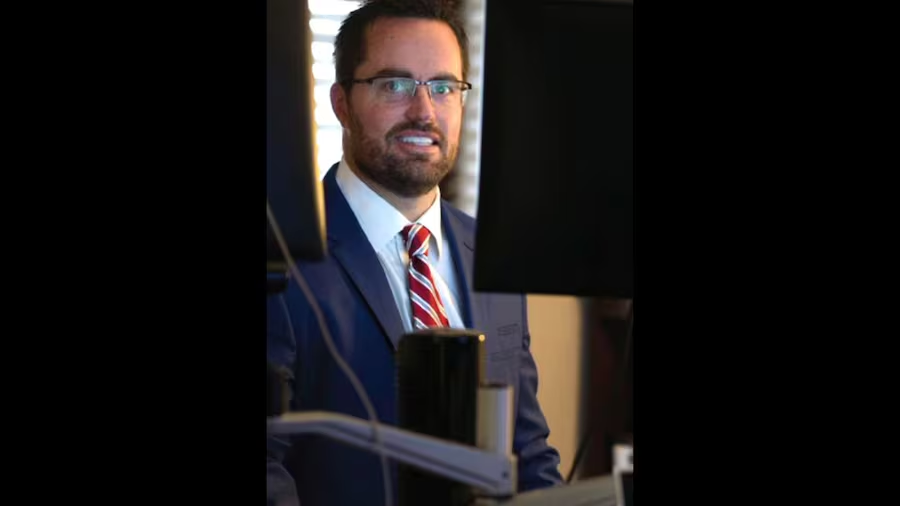
On a sunny afternoon in March, Fred Piccolo pulled his car over on a residential street in Manatee County, police say, blocking the path of a woman walking on the side of the road.
Piccolo, New College of Florida’s director of media and marketing, said that he’d just been caught by his girlfriend’s husband and needed help with directions, according to an arrest warrant filed in Manatee Circuit Court last week.
When she looked inside the car, the report said, the unnamed woman saw that Piccolo was completely naked and touching his genitals.
Piccolo was arrested last week and charged with indecent exposure in the wake of the incident. The school terminated his employment the next day, after receiving questions about the incident from the media,according to text messages reviewed by the Tampa Bay Times.
It wasn’t the first time Piccolo has faced such charges.
When New College of Florida hired him in December, he was facing three pending cases for “exposure of sexual organs.” Two years before that, he was sued for allegedly sending lewd messages to a state lawmaker. That suit was dropped but still covered in the press.
However, none of the cases showed up in a background check requested by the school, nor did Piccolo voluntarily disclose them, according to documents obtained by the Times.
In August, Piccolo entered a changing room at a Banana Republic inside Sarasota’s University Town Center Mall and removed his clothes before calling an employee over, according to a police report. The employee told the police that Piccolo was masturbating while looking at her. Two weeks later he twice retuned to a Dillard’s in the same shopping center and exposed himself to store employees, according to police.
State prosecutors filed three charges of indecent exposure in Sarasota County court in early October. Since the cases were misdemeanors, Piccolo was not arrested and instead received a criminal summons from the Sarasota Clerk of Courts.
Despite these charges, a January background check performed by the Florida Department of Law Enforcement at the request of New College indicated that “no relevant criminal records” existed for Piccolo.
Charges that don’t result in an arrest do not show up on a Florida Department of Law Enforcement background check, according to the agency’s website, which may explain why Piccolo’s prior cases went unrecorded. Cases in which an arresting agency doesn’t take fingerprints and submit them to the state won’t show up either, a Florida Department of Law Enforcement spokesperson said via email.

Piccolo was released from Manatee County jail last week. He was placed under house arrest and is required to wear a GPS ankle monitor. As a result of the recent arrest, at a hearing Thursday in Sarasota, he was required to post a $75,000 bond for his three other pending cases.
Each of the three Sarasota cases carries a penalty of up to one year in jail and a $1,000 fine. The Manatee case, being a second offense, is a third-degree felony and carries a maximum sentence of five years in prison and a $5,000 fine.
Piccolo’s lawyer, Eric Reisinger, declined to comment on the pending cases.
Past turmoil, ties to Corcoran
This is the third time in the past five years that Piccolo’s employment has ended in public scandal.
In 2021, Piccolo resigned from his role as Gov. Ron DeSantis’ communications director after making national headlines for a tweet criticizing news coverage of COVID-19 victims. Piccolo said at the time his decision to leave DeSantis’ office was made prior to his tweet.
The next year, Piccolo was accused in a civil lawsuit of sending “unwanted, unsolicited, inappropriate, and grossly offensive” text messages to then-Florida Rep. Jackie Toledo, R-Tampa,while working as her campaign manager.
Piccolo denied the accusation at the time and the lawsuit was eventually dropped.
In both cases, Piccolo’s next move was to organizations helmed by New College of Florida president Richard Corcoran, with whom he’s had a decade-long professional relationship — stretching back to 2016, during Corcoran’s stint as House speaker.
After leaving DeSantis’ office in 2021, Piccolo joined the Florida Department of Education, serving as executive vice chancellor of state colleges under Corcoran.
Piccolo started a private media company in 2023, after his split with Toledo, and began working for New College through a third-party vendor, according to David Brickhouse, the school’s vice president of legal affairs. He was hired full-time in December. Corcoran was listed a reference on his job application.
Corcoran told the Times that he had no prior knowledge of Piccolo’s pattern of behavior. But Piccolo’s increasingly erratic actions weren’t a complete surprise, according to his father.
Rick Piccolo explained in an email to the Times that his son’s “impulsive and compulsive behaviors, including gambling and hypersexual activities” were side effects from medications used to treat early onset Parkinson’s disease.
Impulse control disorders, including compulsive exhibitionism, occur in nearly 1 in 10 Parkinson’s patients under 65, according to the American Parkinson Disease Association.
Piccolo’s health issues were known to some of his colleagues, according to text messages reviewed by the Times. One, from public relations consultant Katy Saeger to Corcoran, acknowledged that Piccolo “hasn’t been well.” It is not clear whether his behavioral issues were openly discussed.
In his New College application, Piccolo was asked whether he had been convicted or pleaded no contest “to a criminal offense or first-degree misdemeanor” or been sued for causing “death or injury to a person or for causing any property damage.”
He answered no to both.
In lieu of providing advanced written notice of his firing, the school agreed to pay Piccolo four weeks’ salary plus owed vacation time — a lump sum of more than $8,000 — according to his termination letter.
Brickhouse said that had New College fired him with cause, there could have been “a potentially prolonged investigation and response period, during which the employee would continue to receive their full salary and benefits.”
When asked if New College may update its hiring procedures to avoid future oversights, Brickhouse said the school “routinely reviews and reevaluates its policies and procedures to ensure they are thorough and effective and will continue to do so moving forward.”