

College Inside

Sign up for the newsletter
A newsletter about the intersection of higher education and criminal justice. By Charlotte West.
“Today was a pretty good day,” said Dell Pippins.
It was his first day teaching a class as a college professor. Three years ago, he was tutoring fellow students inside Anamosa State Penitentiary in Iowa. He taught GED courses and math lessons before, but it was never his own classroom.
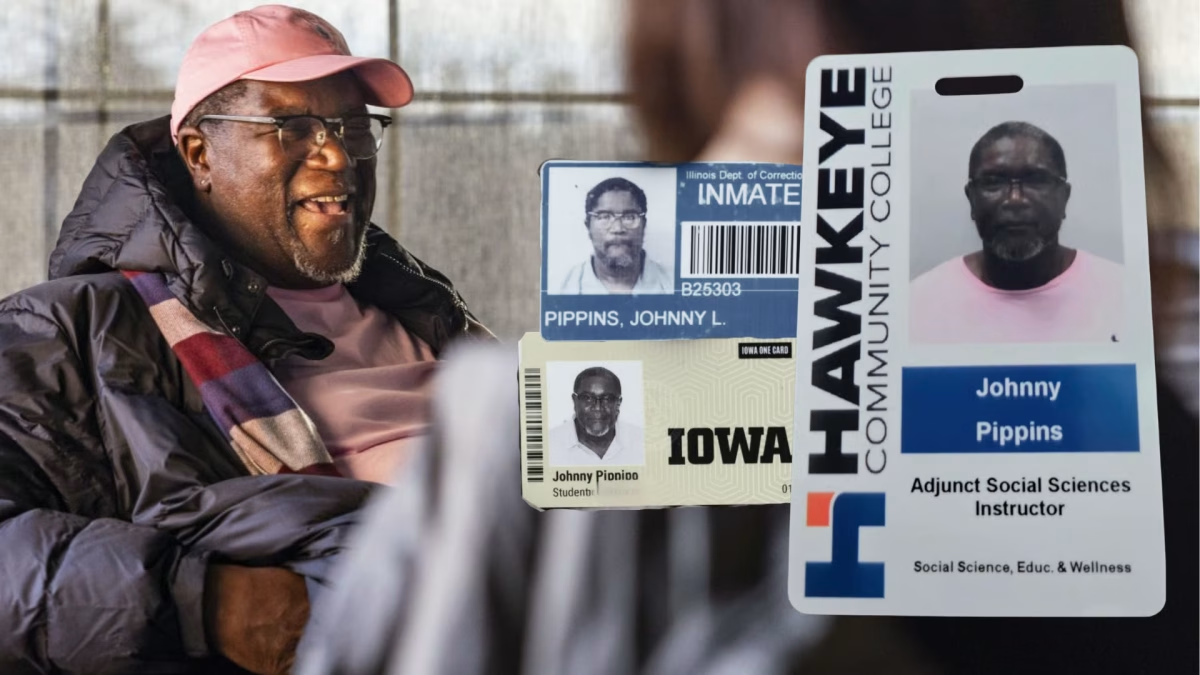
Now, it’s his name on the course syllabus at Hawkeye Community College in Waterloo, Iowa. Pippins is teaching Introduction to Sociology this fall. It’s a fitting milestone for someone who has carried more than one identification card: a prison ID, a student ID, and now an adjunct faculty one.
In 2023, Illinois Gov. JB Pritzker granted him clemency, commuting his sentence and releasing him early to allow him to pursue a Ph.D. at the University of Iowa. Pippins, who grew up in Chicago, spent more than 26 years behind bars for crimes committed in the Quad Cities in Illinois and Iowa in the late 1990s.
Standing in front of his own classroom for the first time, Pippins said his mind went back to prison. “I kind of just left the room,” he said. “I was back in Anamosa, just dreaming about that. It was just the fruition of this dream that I’ve been having for so long.”
Pippins is now a fourth-year Ph.D. student at the University of Iowa, studying how people learn — particularly people whose education, like his own, was interrupted for years. It’s been an eventful transition: he started out in criminology, but switched programs, a shift he said followed a challenging first year back on campus.
“Home life, marital life, school life, even society has changed so much,” Pippins said. After nearly three decades inside, he came home to a world that had moved on in ways large and small: more visible homelessness, and social rules to relearn, like the fact that people text before they call now, and call before they show up. He said he highly underestimated reentry, even with a strong support system in his wife, Tracy, the home they share, and his children and grandchildren.
And before he set foot on the University of Iowa campus in 2023, he’d never actually attended college in person. He earned his bachelor’s degree through a correspondence program and his first master’s degree online, both while still incarcerated. He applied to the Ph.D. program, and was accepted, while he was still in prison.
Pippins said graduate programs like his tend to push students toward research universities, where the emphasis is on publishing, not classroom teaching. He wants to go a different direction. He wants to teach — and specifically, to reach students who are transferring out of community colleges to finish their degrees at four-year schools.
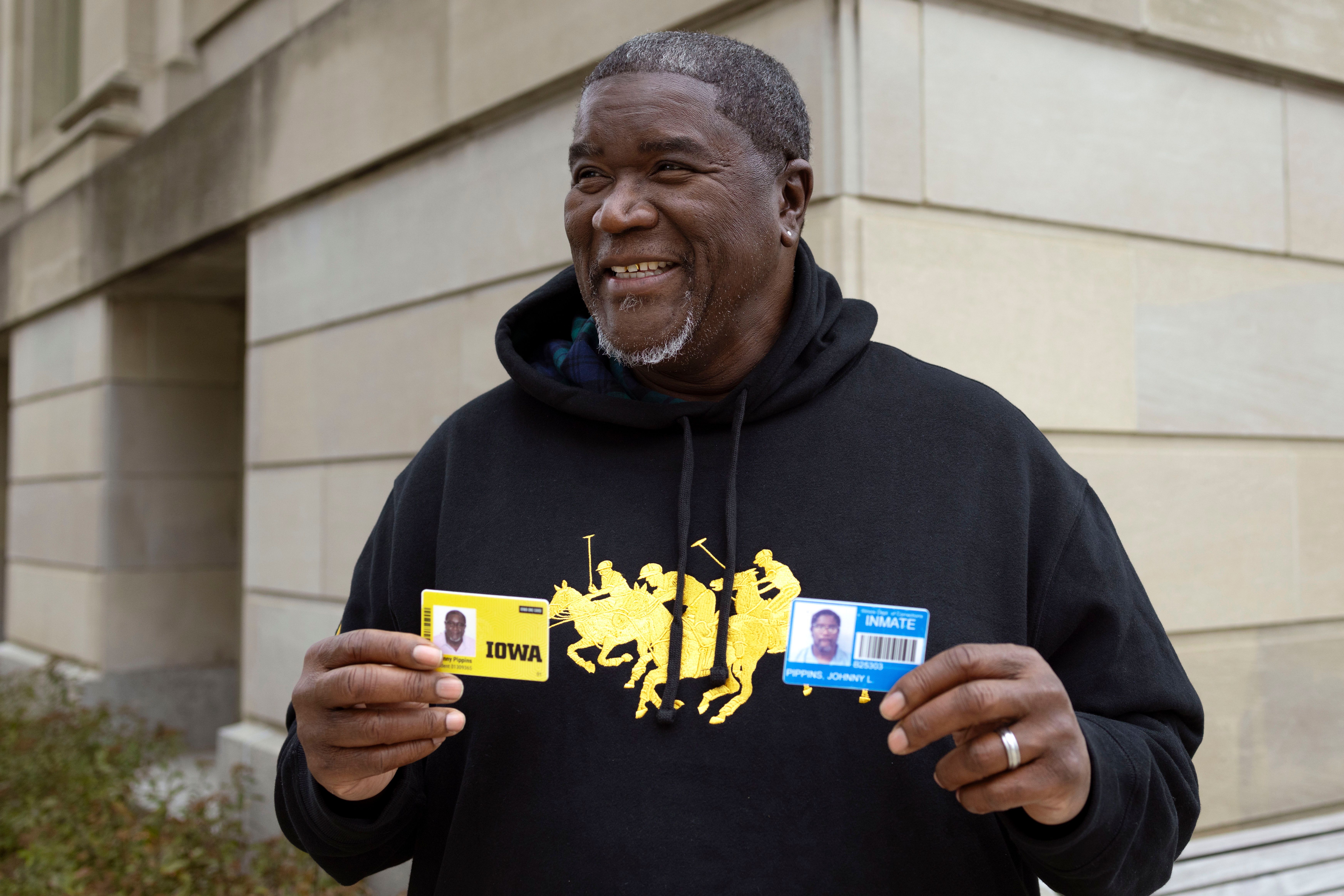
Pippins will soon turn 57. He says teaching is something he can do for the rest of his working life.
His students come from a range of backgrounds and career tracks. In a recent class, he asked students why people commit crime, and pushed the conversation until a student studying to go into law enforcement offered that where someone grows up probably has something to do with it. It was the opening Pippins was looking for: the moment when a student started looking past the person to the conditions around them.
He said he wants all of his students to leave his class starting from empathy: to look at the conditions that shape a person’s life before rushing to judge the person.
Pippins is also set to soon start teaching incarcerated students studying by correspondence — the same kind of program he completed himself by mail while incarcerated. There are plenty of people telling incarcerated students they’re wasting their time and money on education, he said, and he wants to be an example of what’s possible. “The first thing that I want them to see is that it’s possible,” he said. “I’m here teaching you,” he said. “This is full circle.”
Pippins has another message for people following his story from inside. The discipline that gets a person through a long sentence doesn’t stop mattering once they’re out, he said.
“That same perseverance that it takes to make it through there and come home — you’re going to need here.” Reentry, he said, takes humility, and sometimes doing work that feels beneath you, just to stay free. “Think about the times you prayed to get right where you are now. Just think about those times.”
Related: Listen to the audio story about Dell Pippins’ first year at the University of Iowa produced by our partner WBEZ.
Let’s connect
Please connect if you have story ideas or just want to share your experience with prison education programs as a student or educator. You can always reach me at charlotte@opencampusmedia.org or on Bluesky, LinkedIn, or Instagram. To reach me via snail mail, you can write to: Open Campus, 2460 17th Avenue #1015, Santa Cruz, CA 95062.
We know that not everyone has access to email, so if you’d like to have a print copy College Inside sent to an incarcerated friend or family member, you can sign them up here. We also publish the PDFs of our print newsletter on the Open Campus website.
There is no cost to subscribe to the print edition of College Inside. But as a nonprofit newsroom, we rely on grants and donations to keep bringing you the news about prison education. You can also donate here.
Interested in reaching people who care about higher education in prisons? Get in touch at sales@opencampusmedia.org or request our media kit.